
 发表时间:2026-03-16
 资源来源:原创文章
 阅读次数:3256 次
COWAP亚太分会与IPSO联合举办网络研讨会 中国成员分享女性分析关系的临床思考
2026年3月8日国际劳动妇女节当日,由国际精神分析协会女性与精神分析委员会(COWAP)亚太分会与国际精神分析候选人组织(IPSO)联合主办的线上研讨会 “Women Analysing Women Today”成功举行。今年研讨会的主题为:WOMEN ANALYSING WOMEN TODAY(当代女性分析女性),聚焦于做女人没有唯一的方式。来自亚洲及其他地区的精神分析学者围绕女性主体性、临床经验与文化语境展开深入讨论,吸引了50余名多国精神分析师与候选人在线参与。来自IPA中国学组的两位候选人侯迎春、李煦在会上做了报告。
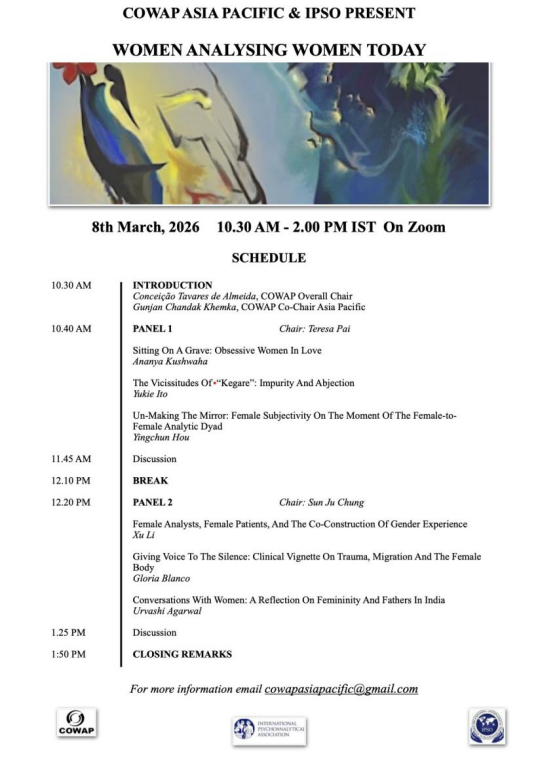
在临床相遇中,作为分析师,我们常常受邀去遭遇女性气质的多种表达--有些挑战着我们自身的欲望与幻想,另一些则揭示了我们内隐的偏见。这些时刻能够质疑既有的理论与技术,为新的思考方式、存在方式与合作方式开辟路径。在精神分析理论传统中,多位学者曾反思女性分析师与女性患者之间的独特动力学。正如加利特·阿特拉斯(2016)提醒我们,我们永远无法“确切地知道什么属于我们自己,什么属于我们的患者;我们的心灵相互交织,投射与内摄交错,我们的叙事是共同创造的”。在本次网络研讨会中,我们试图探索发生在两位女性之间的精神分析性相遇——这种相遇承载着其自身的复杂性与意义。罗辛·佩雷尔伯格(2018)、杰奎琳·戈德弗林德(2018)以及雅尼娜·沙斯盖-斯米尔格尔(1986)等许多作者都曾反思过当分析师与患者皆为女性时涌现的独特动力学。这样一种构型能够唤起特定的运动、状态与阻抗。与此同时,父权制结构与规训——深嵌于社会各处——塑造着女性的主体性,并影响着分析设置中发生的工作。那么,两位女性之间的“自由悬浮”对话会呈现何种面貌?
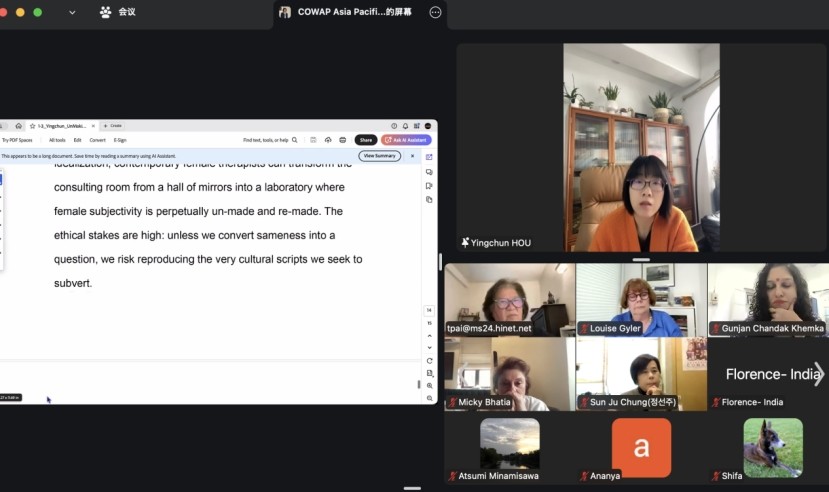
此次研讨会上,四组候选人侯迎春呈报的主题为:Un-Making the Mirror: Female Subjectivity on the Moment of the Female-to-Female Analytic Dyad(打破镜像:女性-女性分析二元中的女性主体性),探讨了女性治疗师与女性患者之间的治疗关系,指出共同性别身份带来的特殊张力与无意识压力,强调“同一性”并非优势而是需要持续质询的空间,提出通过技术策略将咨询室转化为女性主体性不断重塑的实验室。
五组候选人李煦呈报的主题为:Female Analysts, Female Patients, and the Co-Construction of Gender Experience(女性分析师、女性来访者与性别体验的共同建构),展示了性别作为一种在分析性相遇中共同构建的关系性体验。借助主体间性的视角,探讨了性别期待与社会规范、道德认同如何在女性分析师—女性来访者配对中塑造分析过程,尤其是中国文化语境下的情况,并探讨了过度的共情与理想化如何可能导致无意识的共谋与分析停滞。
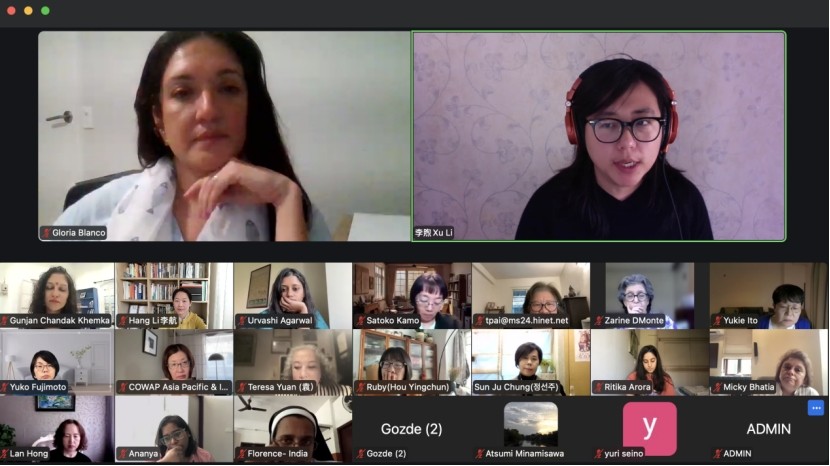
与会人员在讨论环节中对两位中国学组候选人的报告给予积极回应并展开了热烈讨论,认为其将临床经验与当代精神分析关于性别与主体间性的理论对话结合,为理解女性分析关系中的复杂动力提供了富有启发性的视角。
本次研讨会在国际精神分析协会框架下搭建了跨文化交流平台,展示了亚太地区精神分析工作者在女性研究与临床实践中的多样探索。中国学者的参与也进一步促进了中国精神分析界与国际同行之间的学术对话与合作。
COWAP Asia-Pacific and IPSO Jointly Host WebinarChinese Members Share Clinical Reflections on Female-to-Female Analytic Relationships
On International Women's Day, March 8, 2026, the online seminar "Women Analysing Women Today," jointly organized by the Committee on Women and Psychoanalysis (COWAP) Asia-Pacific of the International Psychoanalytical Association (IPA) and the International Psychoanalytical Studied Oganization (IPSO), was successfully held. This year's seminar theme, WOMEN ANALYSING WOMEN TODAY, focused on the understanding that there is no single way to be a woman. Psychoanalytic scholars from Asia and other regions engaged in in-depth discussions on female subjectivity, clinical experience, and cultural contexts, attracting over 50 psychoanalysts and candidates from multiple countries to participate online. Two candidates from the IPA China Study Group, Hou Yingchun and Li Xu, presented their papers at the conference.In clinical encounters, as analysts, we are often invited to encounter diverse expressions of femininity—some challenging our own desires and fantasies, others revealing our implicit biases. These moments can question existing theories and techniques, opening pathways to new ways of thinking, being, and collaborating. Within the psychoanalytic theoretical tradition, numerous scholars have reflected upon the unique dynamics between female analysts and female patients. As Galit Atlas (2016) reminds us, we can never "know for sure what belongs to us and what belongs to our patients; our minds are interwoven, projections and introjections crisscross, and our narratives are co-created." In this webinar, we sought to explore the psychoanalytic encounter occurring between two women—an encounter bearing its own complexity and significance. Authors such as Rosine Perelberg (2018), Jacqueline Godfrind (2018), and Janine Chasseguet-Smirgel (1986), among many others, have reflected on the unique dynamics that emerge when both analyst and patient are women. Such a configuration can evoke specific movements, states, and resistances. Meanwhile, patriarchal structures and disciplines-deeply embedded throughout society-shape women's subjectivity and influence the work occurring within the analytic setting. So, what might "free-floating" dialogue between two women look like?At this seminar, Candidate Hou Yingchun from Group 4 presented on the theme: Un-Making the Mirror: Female Subjectivity on the Moment of the Female-to-Female Analytic Dyad. She explored the therapeutic relationship between female therapists and female patients, pointing out the special tensions and unconscious pressures brought by shared gender identity, emphasizing that "sameness" is not an advantage but rather a space requiring continuous interrogation. She proposed transforming the consulting room into a laboratory where female subjectivity is constantly reshaped through technical strategies.Candidate Li Xu from Group 5 presented on the theme: Female Analysts, Female Patients, and the Co-Construction of Gender Experience. She demonstrated gender as a relational experience co-constructed within the analytic encounter. Drawing upon intersubjective perspectives, she explored how gender expectations, social norms, and moral identifications shape the analytic process in female analyst-female patient pairings, particularly within the Chinese cultural context, and examined how excessive empathy and idealization may lead to unconscious collusion and analytic impasse.Participants responded positively to both Chinese Study Group candidates' presentations during the discussion session, engaging in lively debate. They recognized that the candidates' integration of clinical experience with contemporary psychoanalytic theoretical dialogues on gender and intersubjectivity provided illuminating perspectives for understanding the complex dynamics within female analytic relationships.This seminar established a cross-cultural exchange platform under the framework of the International Psychoanalytical Association, showcasing the diverse explorations of psychoanalytic workers in the Asia-Pacific region in women's studies and clinical practice. The participation of Chinese scholars further promoted academic dialogue and collaboration between the Chinese psychoanalytic community and international colleagues.
撰稿(Writer):侯迎春(HOU Yingchun),李煦(LI Xu)
审校(Reviser):QIU Jianyin